
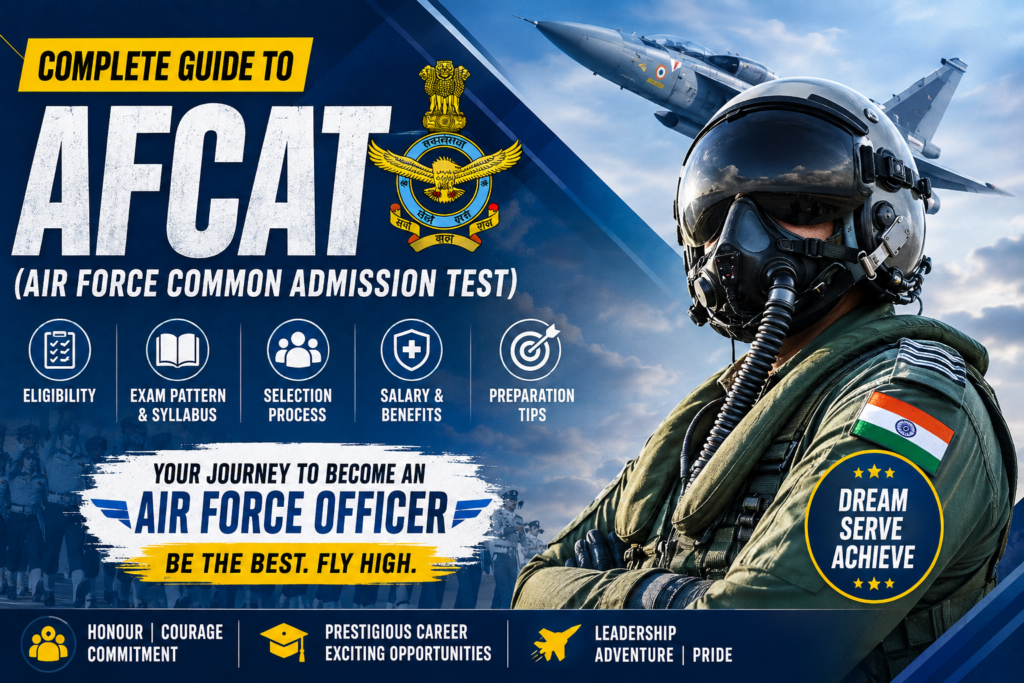
What is AFCAT?
The Air Force Common Admission Test (AFCAT) is a national-level examination conducted by the Indian Air Force to recruit Group ‘A’ Gazetted Officers in:
- Flying Branch
- Ground Duty (Technical)
- Ground Duty (Non-Technical)
The exam is generally conducted twice every year.
Branches Through AFCAT
Flying Branch
- Fighter Pilot
- Transport Pilot
- Helicopter Pilot
- Weapon Systems (as applicable)
Ground Duty (Technical)
- Aeronautical Engineering (Electronics)
- Aeronautical Engineering (Mechanical)
Ground Duty (Non-Technical)
- Administration
- Logistics
- Accounts
- Education
- Meteorology
Eligibility
Nationality
Indian Citizen
Educational Qualification
Flying Branch
- 10+2 with Physics & Mathematics (minimum 50% each).
- Graduation (minimum 3 years) with 60% marks, OR
- E./B.Tech with 60% marks.
Ground Duty (Technical)
- 10+2 with Physics & Mathematics (minimum 50% each)
- Engineering degree in the relevant discipline with minimum required marks.
Ground Duty (Non-Technical)
Depends on the branch:
- Any Graduation (Administration/Logistics)
- Com (Accounts)
- Post Graduation for Education and Meteorology branches as specified in the notification.
Age Limit
Flying Branch
- 20–24 years
- Up to 26 years for candidates holding a valid Commercial Pilot Licence (CPL).
Ground Duty Branches
- 20–26 years (as specified in the notification).
AFCAT Exam Pattern
Subject
- General Awareness
- Verbal Ability (English)
- Numerical Ability
- Reasoning & Military Aptitude
- Total 100 Questions
- Duration: 2 Hours
- Maximum Marks: 300
- Correct Answer: +3
- Wrong Answer: −1
- Unattempted: 0 Marks
- Mode: Computer Based Test (CBT)
- Language: English only.
Syllabus
English
- Reading Comprehension
- Vocabulary
- Error Detection
- Synonyms & Antonyms
- Sentence Completion
- Idioms & Phrases
General Awareness
- History
- Geography
- Polity
- Current Affairs
- Defence
- Sports
- Science
- Environment
Numerical Ability
- Percentage
- Ratio
- Profit & Loss
- Time & Work
- Time-Speed-Distance
- Average
- Number System
- Simplification
Reasoning & Military Aptitude
- Coding-Decoding
- Analogy
- Blood Relations
- Series
- Pattern Recognition
- Spatial Ability
- Logical Reasoning
Selection Process
- AFCAT Written Examination
- Shortlisting based on cut-off
- AFSB Interview (Air Force Selection Board)
- Medical Examination
- Final Merit List
- Training at the Air Force Academy.
AFSB Interview
The interview generally includes:
- Officer Intelligence Rating (OIR)
- Picture Perception & Discussion Test (PPDT)
- Psychological Tests
- Group Discussion
- Group Planning Exercise
- Outdoor Group Tasks
- Personal Interview
- Conference
Flying Branch candidates also undergo additional aptitude testing where applicable.
Medical Standards
Candidates must satisfy prescribed standards related to:
- Height and weight
- Vision
- Hearing
- Physical fitness
- Overall medical health
Medical standards vary slightly by branch.
Salary & Benefits
During training:
- Stipend as notified by the Indian Air Force.
After commissioning:
- Pay starts at Level 10 of the Defence Pay Matrix (basic pay plus Military Service Pay and applicable allowances).
Benefits include:
- Free medical facilities
- Accommodation
- Canteen facilities
- Leave Travel Concession
- Pension/NPS benefits as applicable
- Adventure activities
- Opportunities for higher education and career progression.
How to Prepare
- Study 1–2 hours daily if working, or 3–5 hours daily if preparing full-time.
- Read current affairs every day.
- Improve English vocabulary and comprehension.
- Practice aptitude and reasoning regularly.
- Solve previous years’ AFCAT papers.
- Take weekly mock tests.
- Begin preparing for the AFSB interview alongside the written exam.
Why Choose AFCAT?
- Become a commissioned officer in the Indian Air Force.
- Leadership and adventure-filled career.
- Excellent salary and allowances.
- Prestigious uniform and lifestyle.
- Opportunity to fly military aircraft (Flying Branch).
- Strong work-life balance and professional development.