
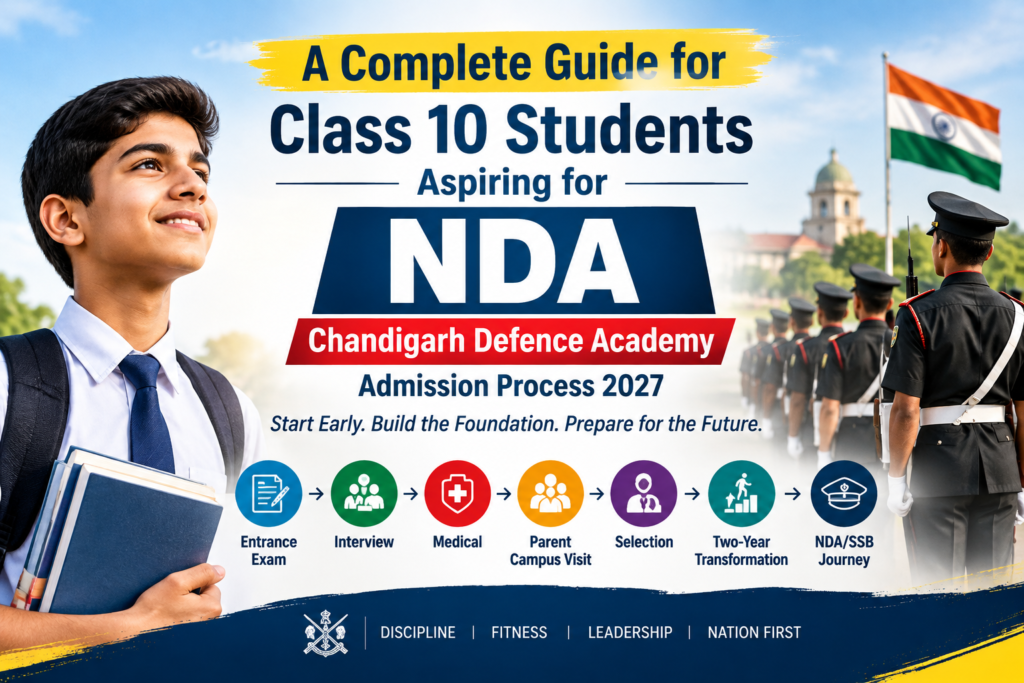
Start Early. Build the Foundation. Prepare for the Future.
Entrance Exam → Interview → Medical → Parent Campus Visit → Selection → Two-Year Transformation → NDA/SSB Journey
For a Class 10 student who dreams of wearing the uniform of an officer in the Indian Armed Forces, the journey does not begin after Class 12. It begins much earlier—with the right academic foundation, discipline, physical fitness, confidence, communication skills and the right environment.
Chandigarh Defence Academy (CDA) has designed an integrated pathway for students who want to pursue Class 11 and 12 schooling while simultaneously preparing for NDA and developing the qualities required for a future defence career.
The Academy’s Two-Year Integrated Agni Programme combines schooling, NDA preparation and residential facilities for students after Class 10. The programme also incorporates personality development, physical fitness and SSB-oriented preparation.
Who Can Apply?
The Chandigarh Defence Academy Entrance Examination is designed primarily for students currently studying in Class 10 who aspire to prepare for NDA and a future career in the Indian Armed Forces.
The entrance examination covers the Class 10 academic foundation. CDA’s published admission information lists English, Mathematics and Science with multiple-choice questions and online examination mode.
The objective is not simply to identify students who score highly.
The larger objective should be to identify students who demonstrate:
- Academic readiness
- Learning ability
- Logical thinking
- Curiosity
- Discipline
- Confidence
- Communication ability
- Willingness to work hard
- Leadership potential
- Physical and mental readiness to develop
Marks may identify academic strength; the interview and subsequent assessment can help understand the student behind the marks.
Step 1: Register for the CDA Entrance Examination
The admission journey begins with online registration.
Students and parents can visit the official Chandigarh Defence Academy website:
www.chandigarhdefenceacademy.in and access the entrance-examination registration facility.
The Academy currently lists its entrance examination for 26 January 2027, with online registration available through its website.
During registration, students are required to provide basic information such as:
Student’s name
- Father’s/Parent’s name
- Class
- School
- Course
- Mobile number
- Address
Parents should ensure that all information is entered correctly because the same information may be used during subsequent stages of admission.
Step 2: Appear for the Online Entrance Examination
The entrance examination is conducted online.
The examination is based on the student’s Class 10 academic foundation, with subjects including:
English + Mathematics + Science
CDA admission information states that the test uses objective-type questions and includes negative marking.
What should students prepare?
Students should revise:
- Class 9 and Class 10 Mathematics
- Fundamental Science concepts
- English grammar
- Vocabulary
- Reading comprehension
- Basic reasoning and application-based questions
- Time management
- Accuracy
However, students should not prepare only for the entrance examination.
They should understand that the entrance test is the first gate—not the final destination.
Step 3: Entrance Examination Result
After the examination, the qualified candidates are shortlisted for the next stage.
The qualified-cadet list is declared after the entrance examination, followed by interviews for final selection.
Entrance Test → Shortlist → Interview → Medical → Final Selection → Admission
Step 4: Personal Interview
The interview is one of the most important parts of the selection process.
- Intelligent quotient/intellectual ability
- Self-confidence
- Personality traits
- Body language
The interviews are conducted by a panel that includes ex-Army officers.
1. Academic Mindset
Does the student understand concepts or simply memorise them?
2. Communication
Can the student express thoughts clearly?
3. Confidence
Can the student speak comfortably without being overconfident?
4. Responsibility
Does the student take ownership of mistakes and tasks?
5. Growth Potential
Most importantly:
Can the student be developed over the next two years?
This is particularly important because a Class 10 student is still developing.
The purpose is to identify officer potential that can be systematically developed.
Step 5: Medical Assessment
After the interview stage, shortlisted students proceed through the required medical/admission formalities.
For parents, this stage is an important part of responsible career planning.
Before committing to a defence-oriented residential programme, parents should understand:
- Physical requirements
- General health considerations
- Fitness expectations
- Vision requirements relevant to future defence entries
- Academic requirements
- NDA eligibility requirements applicable at the time of application
Step 6: Parent Campus Visit
The admission decision is not only the student’s decision.
It is a family decision.
Parents should visit the campus before admission and personally evaluate the environment in which their child will spend the next two years.
School
Parents should understand:
- Schooling system
- Academic schedule
- Faculty
- Classrooms
- Board preparation
- Academic monitoring
NDA Coaching
- Mathematics preparation
- GAT preparation
- NCERT coverage
- Test frequency
- Doubt-clearing system
- Study material
- Performance analysis
Hostel
- Rooms
- Hygiene
- Security
- Warden supervision
- Study environment
- Food and mess arrangements
- Discipline system
- Medical support
- Communication arrangements
Step 7: Understanding the Two-Year Integrated Programme
The Agni Two-Year Integrated Programme is designed for students after Class 10 and combines schooling with NDA preparation and hostel facilities. CDA states that the programme covers Class 11 and 12 and includes NDA-oriented preparation, SSB techniques, communication, confidence-building, physical fitness, testing and mentorship.
The philosophy is simple:
Class 11 + Class 12 + NDA Preparation + Personality Development + Physical Fitness
Instead of preparing for these components separately, the student follows one integrated system.
What Does the Two-Year Journey Include?
School Education
The student continues regular schooling while preparing for the NDA pathway.
The academic foundation remains extremely important because NDA preparation should not come at the cost of Class 11 and 12 performances.
NDA Preparation
The academic programme should progressively develop:
- Mathematics
- English
- General Ability
- Science (PCB)
- Social Science
- Geography
- History
- Current Affairs
- General Knowledge
- Reasoning and application skills
JEE as an Academic Backup
For students choosing the Non-Medical/PCM pathway, maintaining strong academic preparation can create additional opportunities.
A strategically designed programme can therefore prepare students for:
NDA + JEE + Board Examinations
This gives students an additional academic pathway without losing sight of the primary defence objective.
Dream for NDA. Prepare seriously for NDA. But build enough academic strength that your child always has meaningful options.
SSB Preparation from an Early Stage
SSB preparation should not begin only after clearing the NDA written examination.
CDA’s SSB programme focuses on areas such as leadership, communication, confidence, personality and Officer Like Qualities.
For an integrated Class 11–12 student, this development can begin gradually through:
- Group discussions
- Public speaking
- Debates
- Situation-based exercises
- Leadership activities
- Teamwork
- Command tasks
- Outdoor activities
- Personal interviews
- Self-awareness exercises
The objective should be personality development—not artificial SSB acting.
Personality Development
A future officer must be able to:
Think → Communicate → Decide → Lead → Take Responsibility
Therefore, personality development should become a daily activity rather than a once-a-week lecture.
Students can be encouraged to:
- Speak for two minutes every day
- Read newspapers
- Present current affairs
- Participate in debates
- Lead small teams
- Conduct morning briefings
- Maintain a personal journal
- Present projects
- Participate in community activities
Physical Fitness
Physical fitness should become part of the student’s lifestyle.
The programme can include:
- Morning PT
- Running
- Strength development
- Sports
- Obstacle training
- Parade/drill
- Flexibility
- Endurance development
The purpose is to make students physically strong.
It should teach:
Consistency + discipline + endurance + teamwork.
CDA’s integrated-programme includes morning PT, parade drills, sports and outdoor SSB-related activities.
The academy’s role is to prepare students for this journey—not to promise a particular final outcome.
Area What is Measured
Academics School + NDA test performance
Intelligence Reasoning + problem solving
Communication Speaking + expression
Leadership Initiative + responsibility
Physical Fitness Strength + endurance
Discipline Punctuality + routine + conduct
Why Start After Class 10?
The biggest advantage of beginning after Class 10 is time.
Two years provide an opportunity to develop habits gradually rather than attempting to build everything in a few months.
A student can progressively improve:
Knowledge → Fitness → Communication → Confidence → Discipline → Leadership
The Bigger Mission
The larger objective is to help a young student become:
Academically capable.
Physically fit.
Mentally resilient.
Confident in communication.
Responsible in conduct.
Comfortable with leadership.
Disciplined in daily life.
That is why the journey should begin before the NDA examination itself.
Chandigarh Defence Academy
“We Don’t Just Prepare Students for an Examination. We Build the Foundation for a Future Officer.”
Start Early. Study Smart. Build Character. Develop Leadership.
Entrance Exam → Interview → Medical → Parent Campus Visit → Selection → Two-Year Transformation → NDA/SSB Journey